Dog Collar With Name
A collar with a name on it is doing two jobs at once, and they are not the same job. The name is for the dog and for whoever finds it: it is how a stranger gets a frightened animal to stop, look up and stay put. The number is the part that actually ends the search. Everything below is about giving both of them the room they need on a plate the width of a strap.
What actually goes on the plate
You get two lines and twenty characters on each. That is enough for a name and a full international number with room to spare, and it is the reason we do not offer a third line: a third line means smaller letters, and smaller letters are read from closer, which defeats the point of putting the text outside the dog in the first place. Here is how those two lines are usually spent.
| First line | Second line | When it makes sense |
|---|---|---|
| Dog's name | Your mobile number | The default, and what most owners choose. The name opens the conversation, the number ends it. |
| Your mobile number | A second number | Two people share the dog, or you travel and want a landline as backup. |
| Dog's name | "I am chipped" + number | You want a finder to know a vet can identify the dog even if the collar is lost. |
| Your mobile number | Dog's name | The number sits on the upper line, closest to the eye when someone leans over a seated dog. |
Any combination of the two lines is engraved as you type it. Enter the text exactly as you want it cut, including capitals.
Twenty characters is rarely the constraint
It reads like a tight limit until you look at what people actually engrave. On buyers' own photos, the names run to four, five, six letters: short, sharp, and chosen years ago precisely because they carry across a park. A twenty character line leaves most of them half empty, which is exactly where you want to be — the fewer characters on a line, the larger each one is cut, and the further away it can be read.
The number is the line that fills up. A mobile number written with its country code and spaces sits comfortably inside twenty characters, and we would rather you spend the room there than on the name.
Riveted flat, not hanging
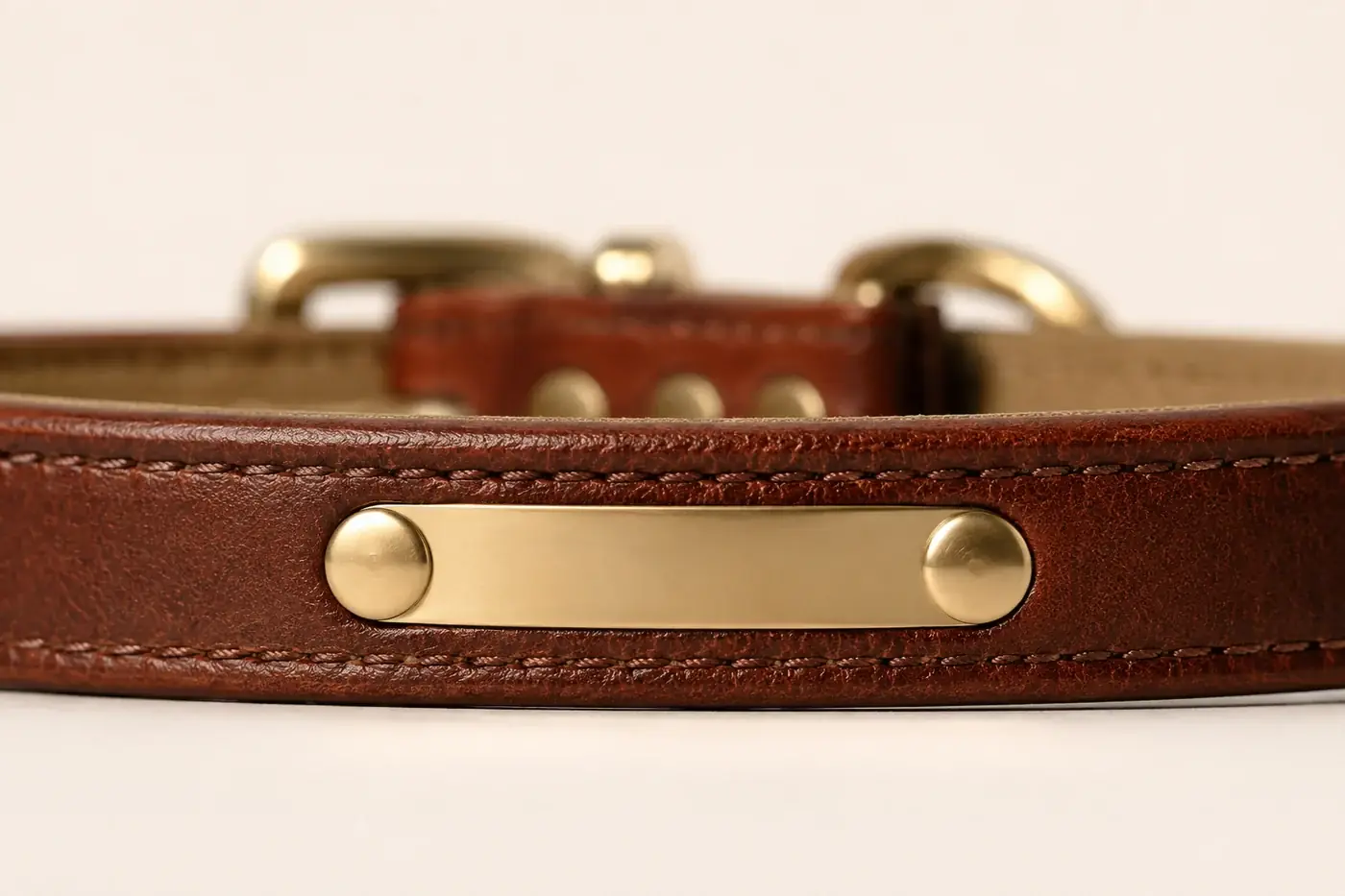
The plate sits on the strap itself and is held by a rivet at each end. Nothing dangles, so nothing swings into a food bowl at six in the morning, nothing catches on a crate door or a fence wire, and there is no split ring to work its way open over a year of walks. A hanging tag has to survive being pulled; a riveted plate is never pulled in the first place.
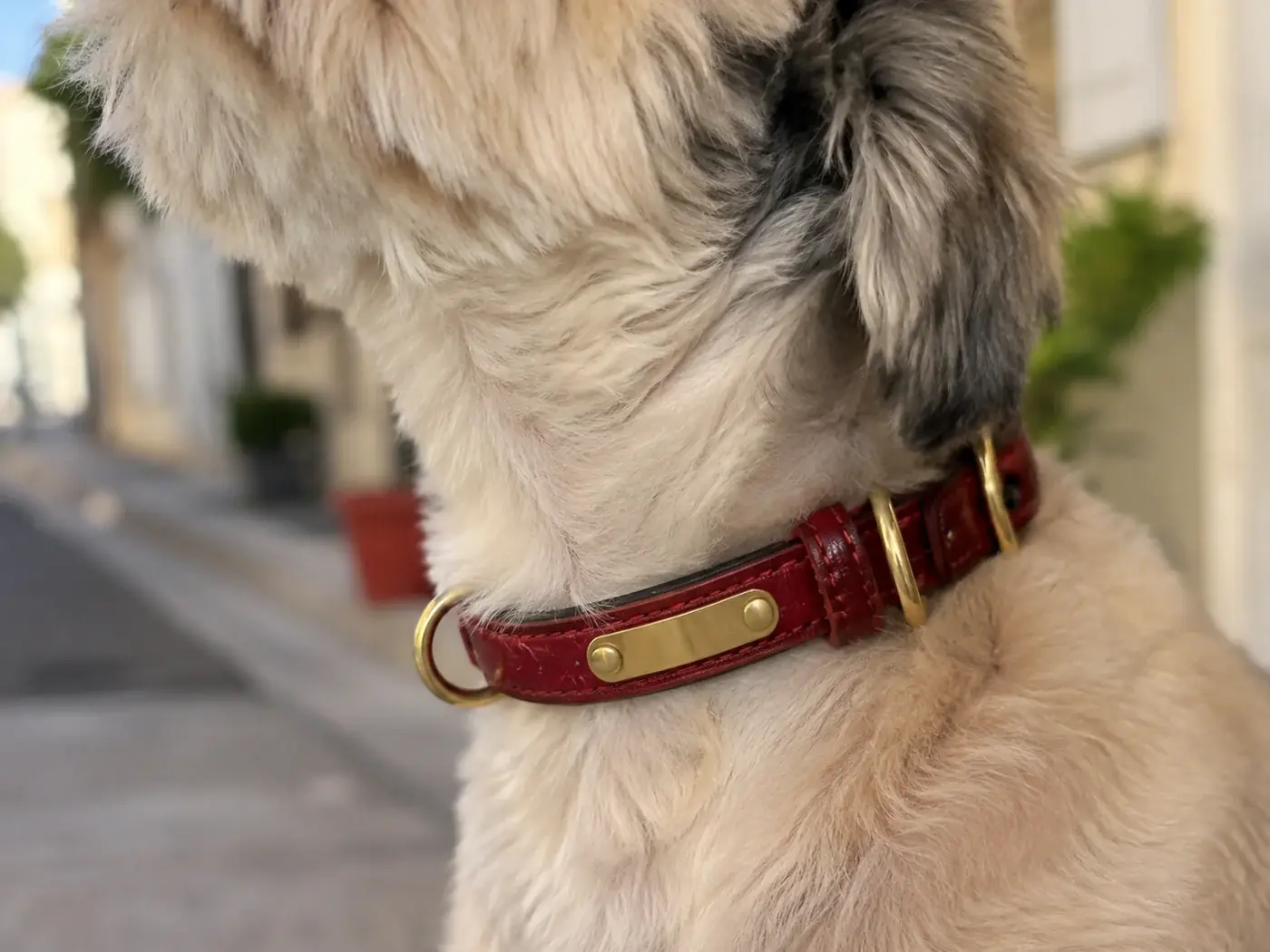
It also stays where the light is. A tag that hangs under the jaw spends most of its life turned away from whoever is looking. A plate on the top of the strap faces outward as long as the collar is snug, which is one more reason to fit it properly rather than buying a size up. Our two-finger check takes about five seconds and settles it.
Cut into the brass, not printed on top
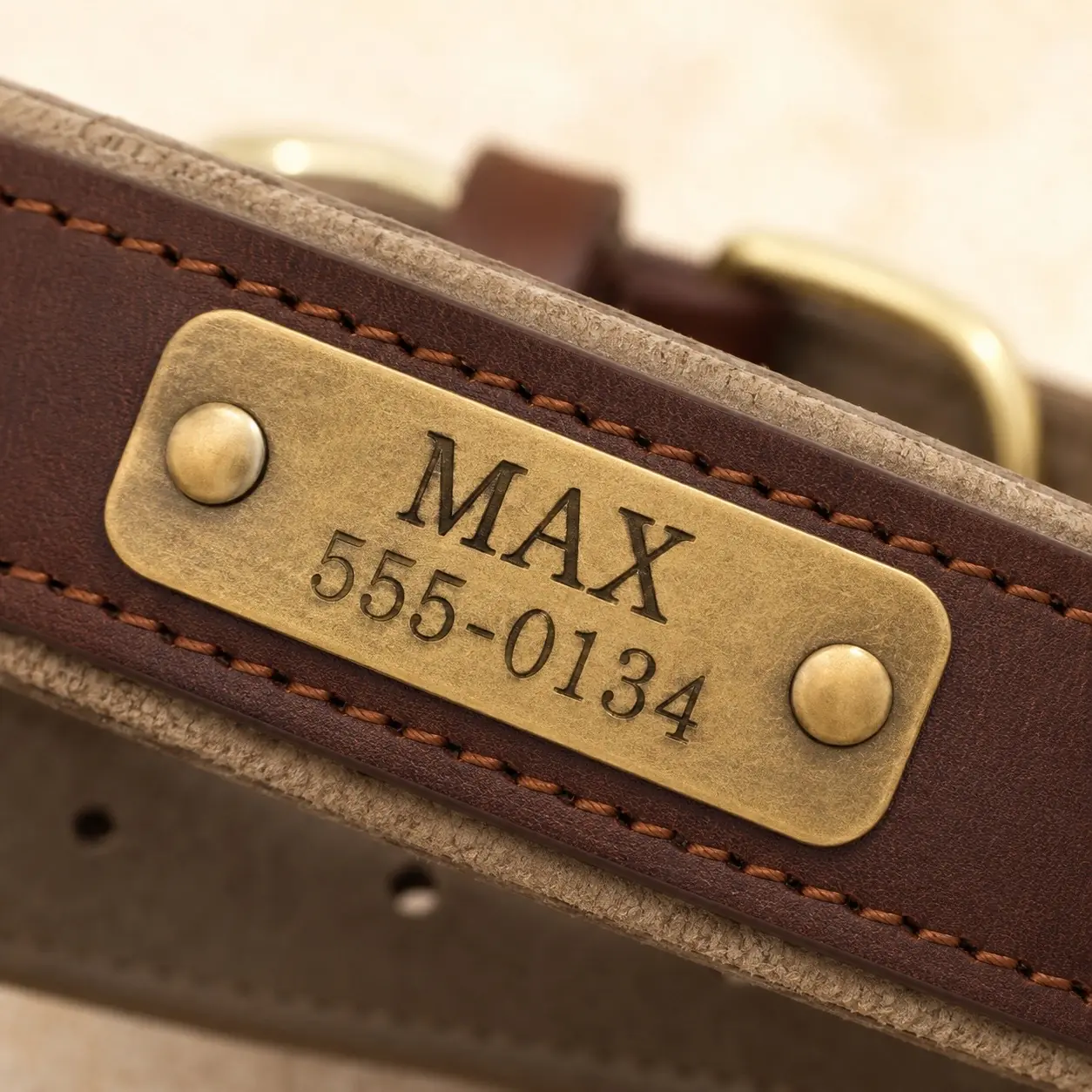
The text is removed from the metal rather than added to it. There is no ink layer, no lacquer over the letters and nothing that can lift at an edge after a wet winter, because there is no layer there at all — the letters are a shallow trench in the brass, and a trench does not peel. One of our buyers put it more plainly than we could: the engraved name is not painted on.
Brass behaves the way brass does. Handled daily, it loses its factory brightness over a few months and settles into a warmer, duller tone. The cut darkens at a different rate from the face around it, which is why the text usually gets easier to read as the collar ages, not harder. A dry cloth restores the contrast whenever you want it back.
Reading distance is the whole point
The question worth asking about any engraved collar is not whether the text looks good in your hand. It is whether a neighbor holding a strange dog by the scruff, at arm's length, in the rain, can read a phone number without reaching for their glasses. That is a question about letter height, and letter height is decided by two things you control: how many characters you use, and how much of the strap the plate covers.
This is why the plate is sized to the strap rather than to a standard blank, and why the larger sizes carry a longer plate. It is also why we would rather engrave Max and a number than Maximilian von Hundehausen and a number.
Get the size right before you engrave
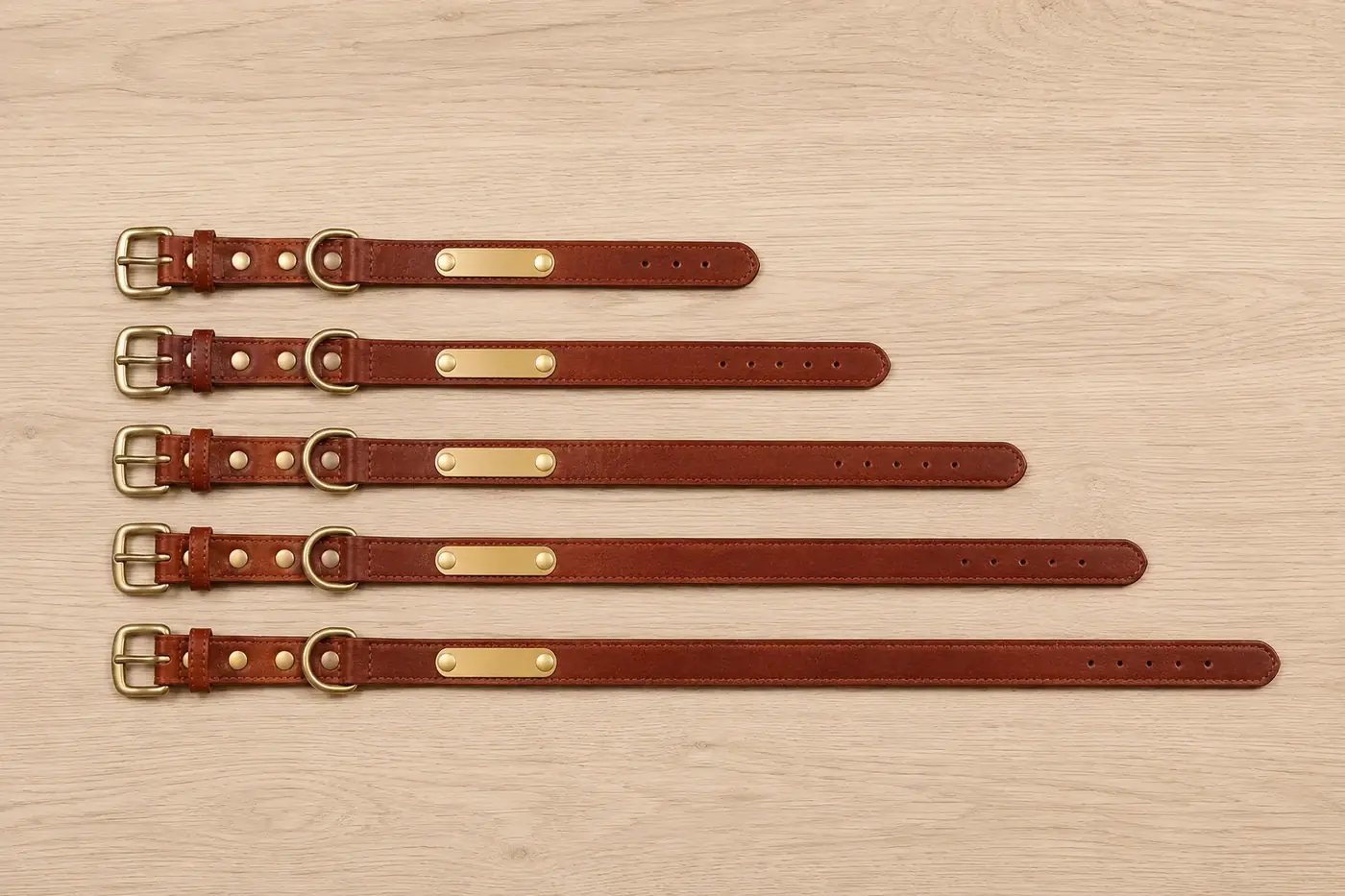
An engraved plate is cut for the collar you ordered, so the size decision comes first and it is the one worth spending two minutes on. Measure the neck with a soft tape where the collar will actually sit — lower than you think, at the base of the neck rather than up behind the ears — and read the number off the tape rather than estimating from the dog's weight. Weight is a poor proxy: two dogs at the same weight can be four inches apart at the neck.
Five sizes cover necks from 7 to 21.5 inches. If your measurement falls on a boundary, take the larger size only if the dog is still growing; otherwise take the smaller one, because a collar with room to rotate puts the plate against the fur instead of facing the world. The full table, with how to measure and what each size fits, is in our dog collar size chart.
Keeping it, in three gestures
Leather that gets wet dries flat and away from a radiator, never coiled tight. Twice a year a thin coat of neutral balm on a cloth keeps the strap supple where it folds at the buckle — that fold is where a dry collar cracks first. The brass dulls; a dry cloth brings it back and it needs no polish.
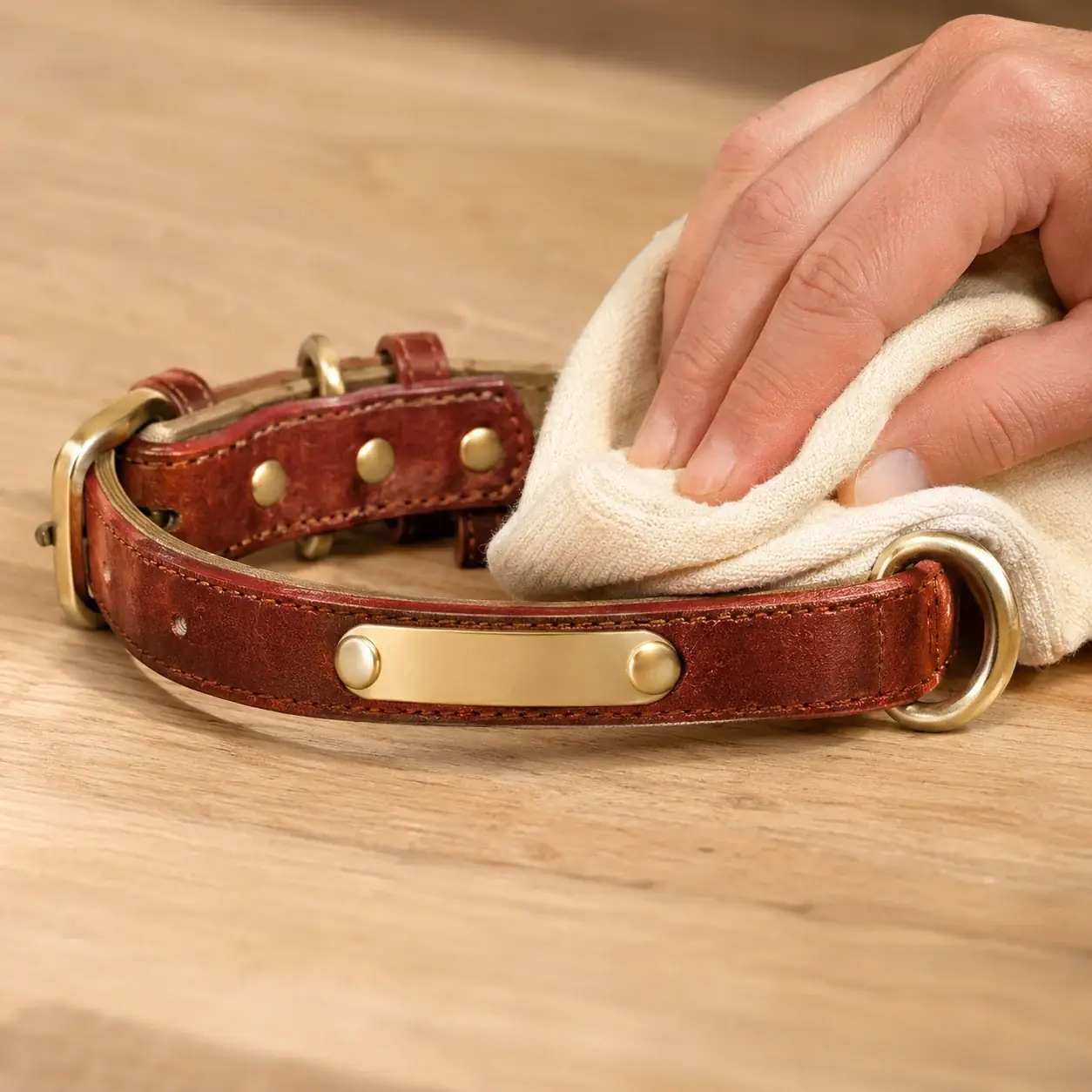 Wipe
Wipe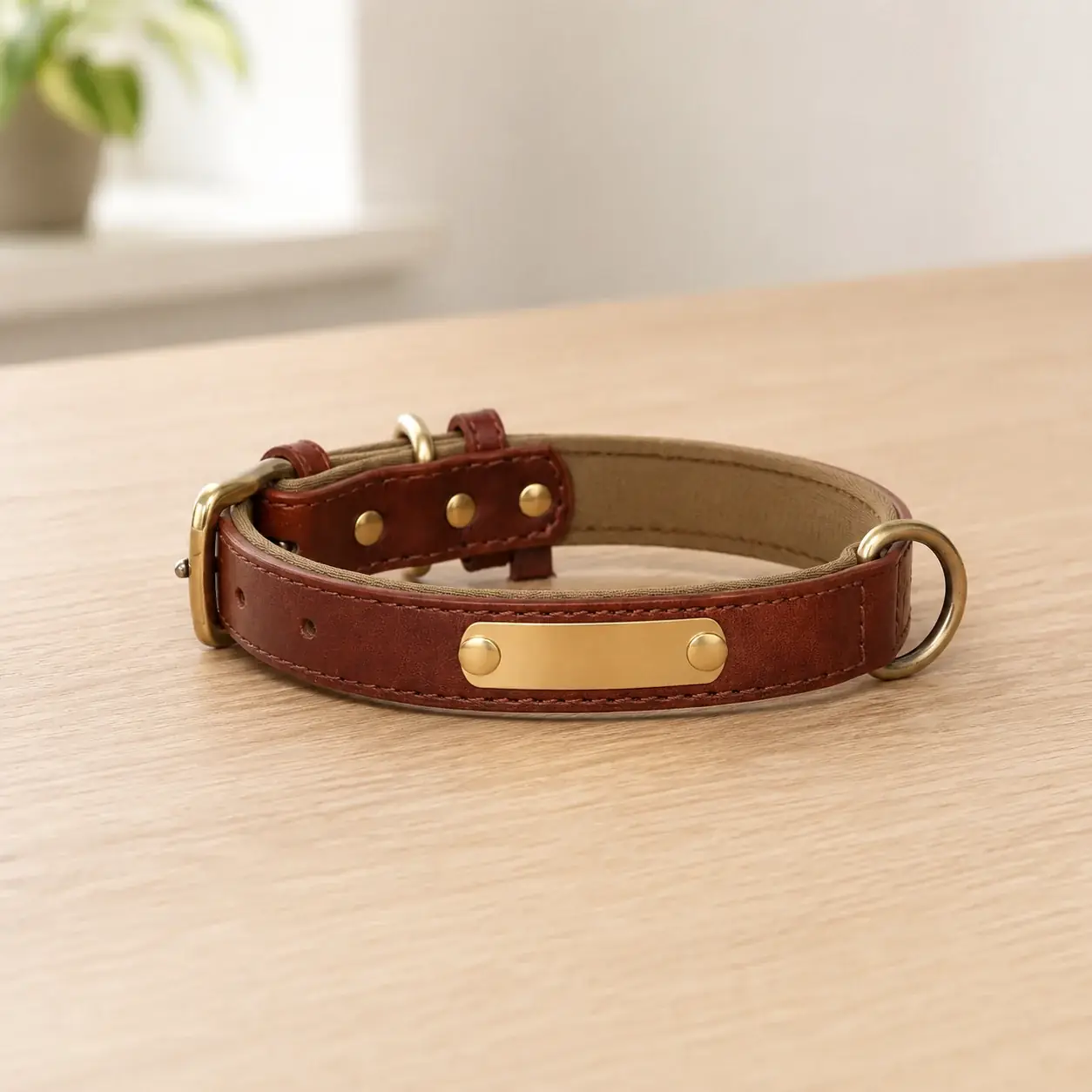 Dry flat
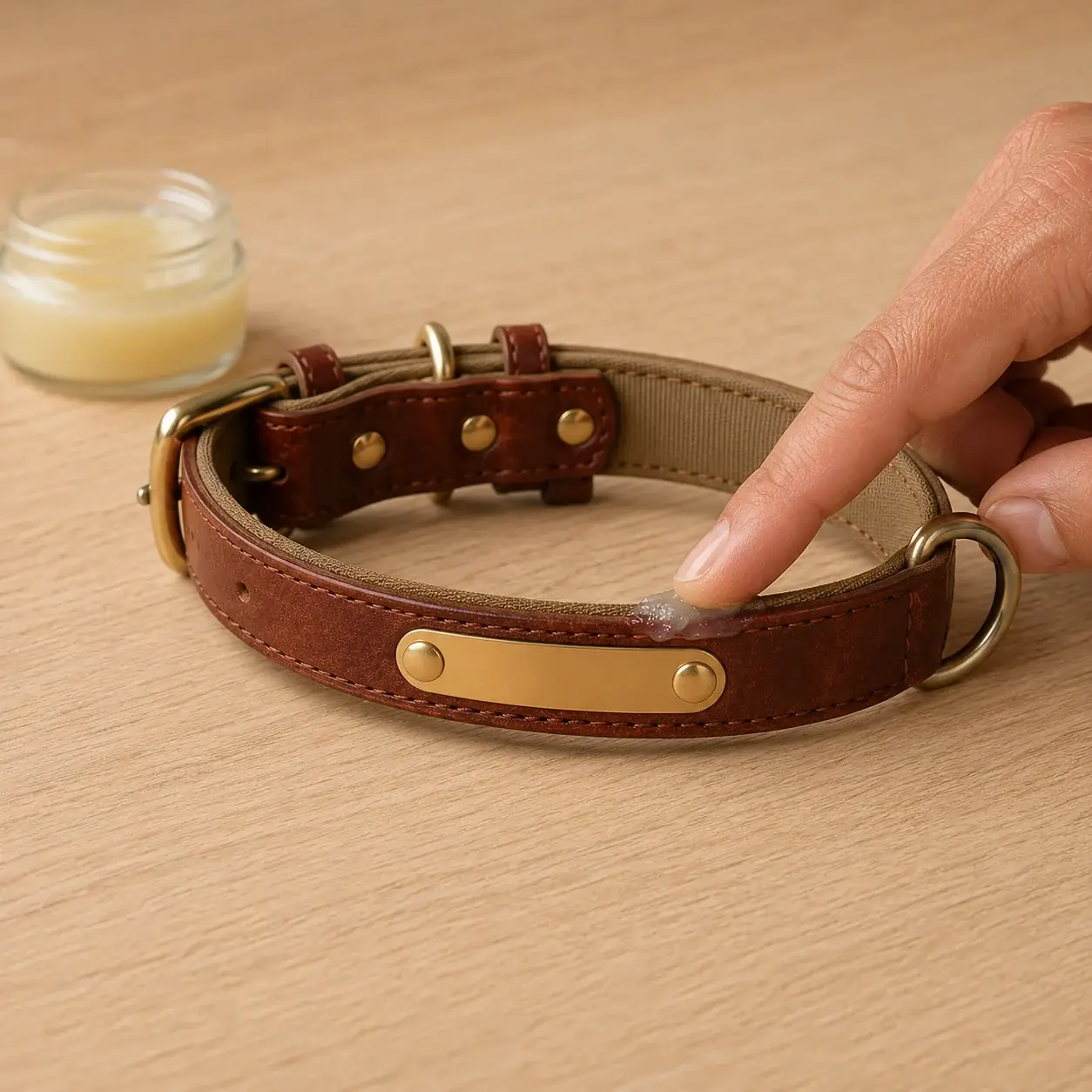 Feed the leather
Choosing the color the plate will sit on
Ten colors, each with a contrasting inner lining, and the brass hardware is the same across all of them. Brass reads warm, so it holds its own against the darker leathers — brown, black, green, red — and sits quieter on the pale ones. There is no wrong answer here and no price difference between them; it is worth a moment only because you will be looking at this collar every day for a few years.
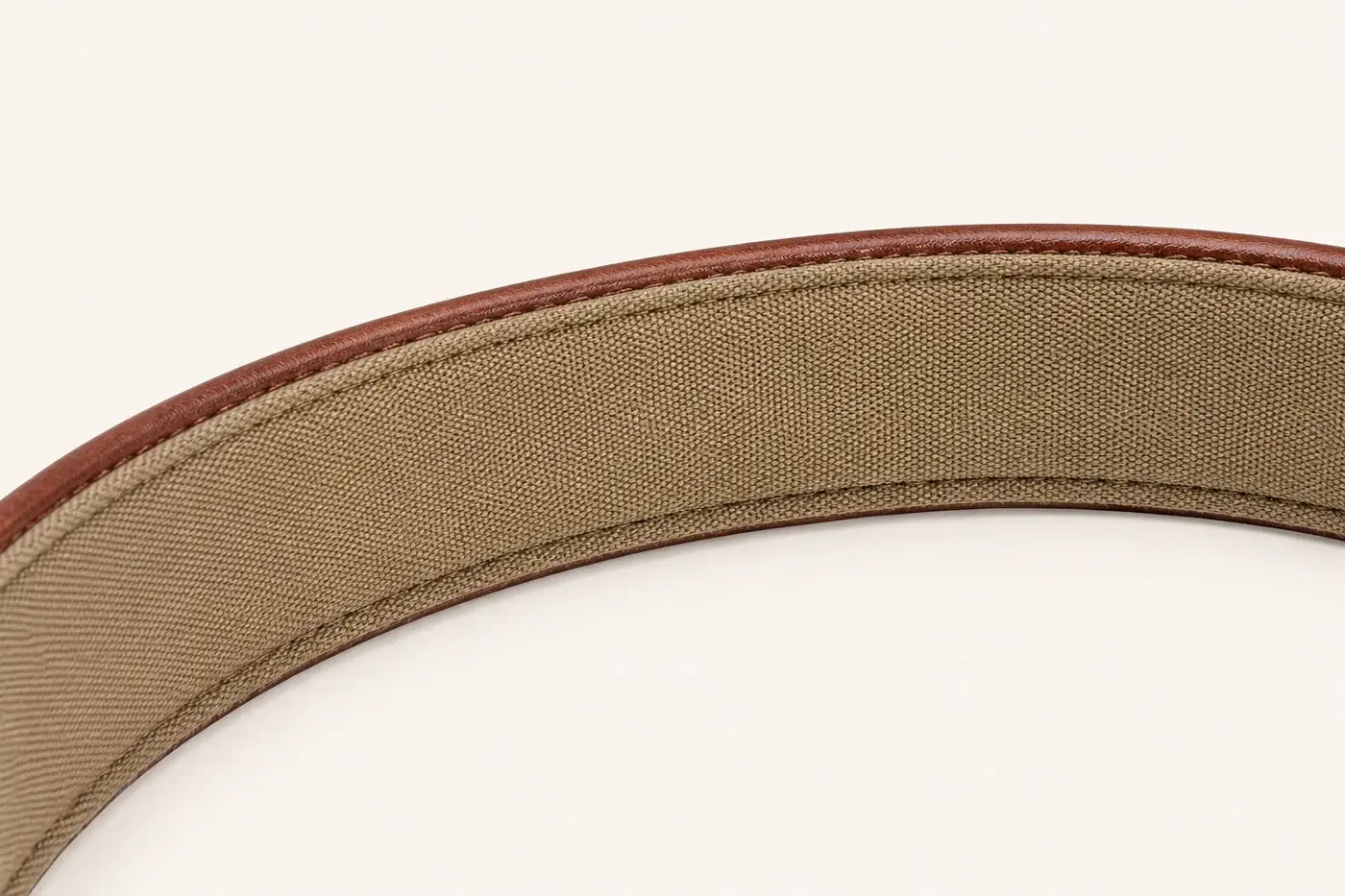
The lining is the part people notice second. It is a different color from the outer leather on every option, which is what you see along the edge of the strap and against the coat. The full range, with the lining shown for each, is on the main product page.
What happens after you order
You enter the two lines at checkout. The plate is cut with that text, fitted to the collar in the size and color you chose, and the finished collar ships to the United States, Canada, the United Kingdom or Australia. Because there is no pre-made version of your collar sitting on a shelf, allow 9 to 14 business days for the engraving and 5 to 8 in transit — 14 to 22 business days door to door. Shipping is free on every order.
Engraving is included in the price on every size and every color. It is not an option to add at the end.
Questions about the engraving
What can I put on a dog collar with a name?
Two lines, up to twenty characters each. Most owners use the dog's name on the first line and one phone number on the second. You enter both at checkout and the plate is cut after you order.
Should I put my dog's name on the collar?
Both choices are defensible and we engrave whatever you send. A name helps a stranger speak to a frightened dog and hold its attention long enough to read the second line. Some owners prefer the number alone. The line that actually brings a dog home is the phone number, so give it the room it needs.
Will the engraving wear off?
It is cut into the brass rather than printed on top, so there is no surface layer to rub away. Brass darkens slowly with handling; the cut stays legible as it does, and a dry cloth brings the contrast back.
How long does an engraved collar take to arrive?
The plate is cut after you order, with the text you enter at checkout, so there is no ready-made version to pull off a shelf. Allow 9 to 14 business days for the engraving and 5 to 8 in transit, so 14 to 22 business days in total.